
You spent hours writing a great blog post. You researched the topic, used the right keywords, and hit publish. But when you search for that topic on Google, you see an AI Overview at the top, and your content is nowhere in it.
Frustrating, right?
You are not alone. Thousands of content creators, marketers, and business owners across the UAE and beyond are facing the same problem right now. Google’s AI Overviews (also known as AI-generated answers or SGE Search Generative Experience) are changing how people find information online. If your content is not part of those answers, you are losing visibility, traffic, and trust.
“The good news? This is fixable. In this guide, we’ll break down exactly why your content isn’t appearing in AI Overviews and share practical tips to help your website get cited by AI tools, improve visibility, and increase its chances of being featured in AI-generated answers.”
What Are AI Overviews and Why Do They Matter?
Before we fix the problem, let’s understand what we are dealing with.
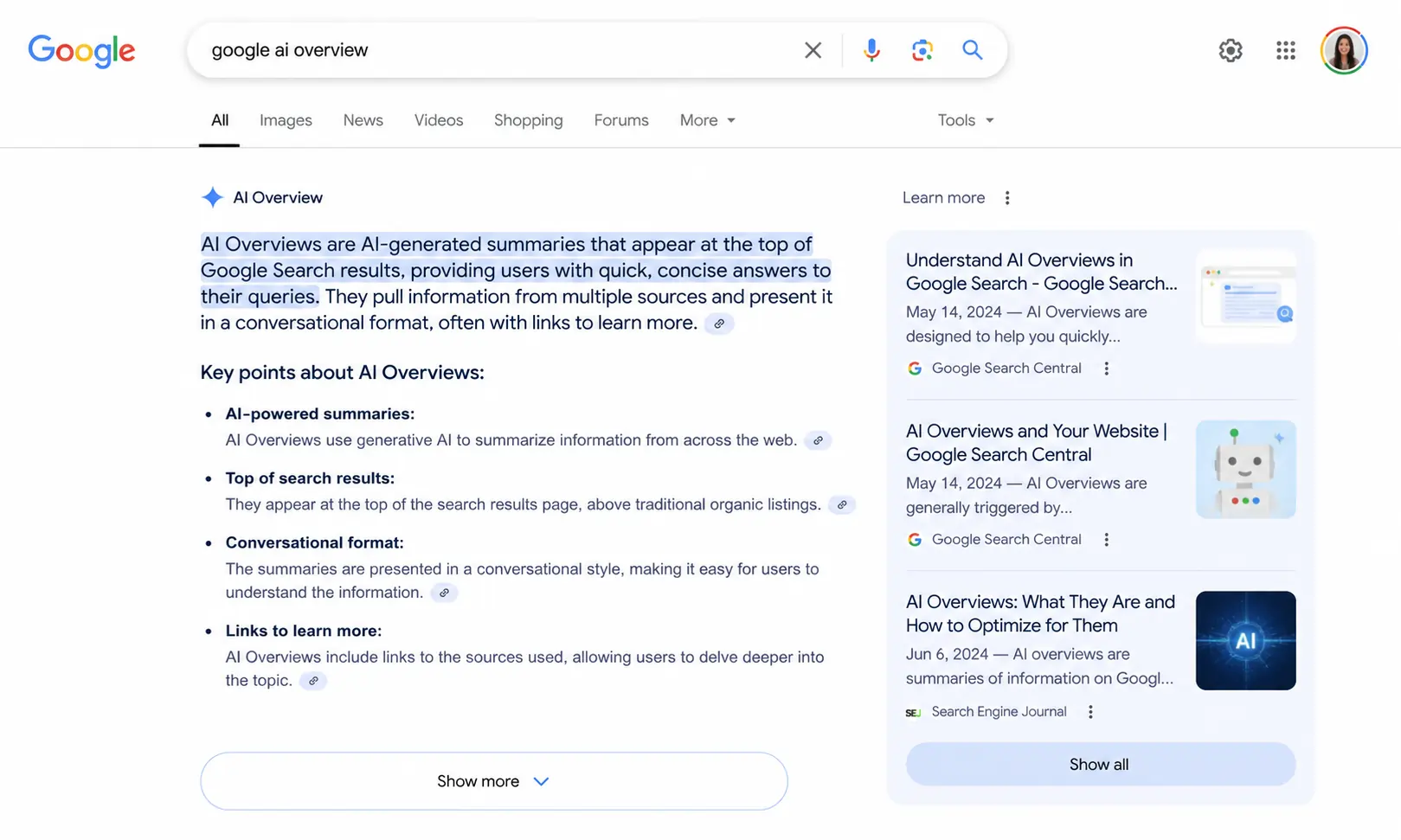
AI Overviews are the AI-generated summaries that appear at the very top of Google search results. They pull information from trusted sources on the web and give users a quick, clear answer without them needing to click on any link.
Google launched this feature widely in 2024, and since then, it has changed the entire search landscape. Studies show that AI Overviews appear in around 11 to 15 percent of all Google searches, especially for informational and question-based queries.
If your content gets cited in an AI Overview, it can bring massive exposure even if you are not ranked number one. But if Google does not trust or understand your content, it simply won’t include you.
Why Is Your Content Not Showing Up in AI Overviews?
There are several common reasons your content is being left out. Let’s go through each one clearly.
Your Content Lacks Topical Authority
Google’s AI system looks for content from sources that deeply cover a specific topic. If your website only has one or two articles on a subject, Google may not see you as an authority. Topical authority means publishing multiple well-connected pieces around the same subject so Google understands you truly know what you are talking about.
Think of it this way. If someone asks a question about digital marketing strategy, Google will prefer a website that has 20 related articles on marketing over a website that only has one.
Your Content Does Not Directly Answer the Question
AI Overviews are built to give fast, clear answers. If your blog post takes too long to get to the point, or buries the main answer deep in the article, Google’s AI will skip it.
The ideal structure is what SEO experts call the “answer first” approach. You put the direct answer within the first two to three sentences, then explain it in detail below.
You Are Missing Structured Data and Schema Markup
Schema markup is a type of code added to your website that helps search engines understand your content more clearly. It acts like labels for your information, showing Google which sections contain definitions, step-by-step instructions, FAQs, and other important details. Without schema markup, search engines have to work harder to interpret your content.
With it, your pages become easier to understand, increasing the chances of appearing in AI-generated summaries. See how Schema markup also matters for local SEO, and as it helps search engines better understand your business details, location, services, and customer information, improving your visibility in local search results.
Your Content Has Low E-E-A-T Signals
E-E-A-T stands for Experience, Expertise, Authoritativeness, and Trustworthiness. These are the four signals Google uses to judge whether a piece of content is credible.
If your website does not have an author bio, does not mention who wrote the content, has no external backlinks, or has no signs of real-world experience, Google will see it as less trustworthy. And low-trust content rarely gets picked for AI Overviews.
Your Website Has Technical SEO Issues
Even great content can be invisible to Google if your website has technical problems. Slow loading speed, broken links, missing meta descriptions, unoptimized images, or poor mobile experience can all cause Google to deprioritize your content.
AI Overview selection depends partly on how well your overall website performs, not just the quality of a single article.
Your Content Is Not Semantically Rich
Modern search engines do not just read keywords. They understand meaning, context, and relationships between ideas. This is called Natural Language Processing, or NLP.
If your content only uses one version of a keyword and does not naturally include related phrases, synonyms, and contextual terms, it will rank lower in semantic relevance. Google’s AI looks for content that covers a topic from many angles using natural language.
How To Fix It: Step-by-Step Guide to Getting Into AI Overviews
Now let’s get into the practical solutions. These steps are based on how Google’s AI systems actually work today.
Step 1: Build Topical Authority Through Content Clusters
Start by creating a content cluster. This means picking one main topic and writing multiple articles around it. You have one central “pillar” article that covers the topic broadly, and then several supporting articles that go deeper into specific parts.
For example, if your main topic is “social media marketing in Dubai,” your supporting articles could be about Instagram ads for UAE businesses, TikTok strategy for local brands, or LinkedIn marketing for B2B companies in Abu Dhabi. All these pages should link to each other.
This tells Google you are a serious resource on this subject, which increases your chances of being cited in AI Overviews.
Step 2: Use the “Answer First” Writing Format
Every article you write should answer the main question within the first paragraph. Do not make Google search through 500 words to find your point.
Start with a clear, direct statement. Then build your explanation, evidence, and examples below. This format is also called the Inverted Pyramid style, and it is exactly what AI systems prefer when pulling content for featured snippets and AI Overviews.
Step 3: Add FAQ Sections to Every Article
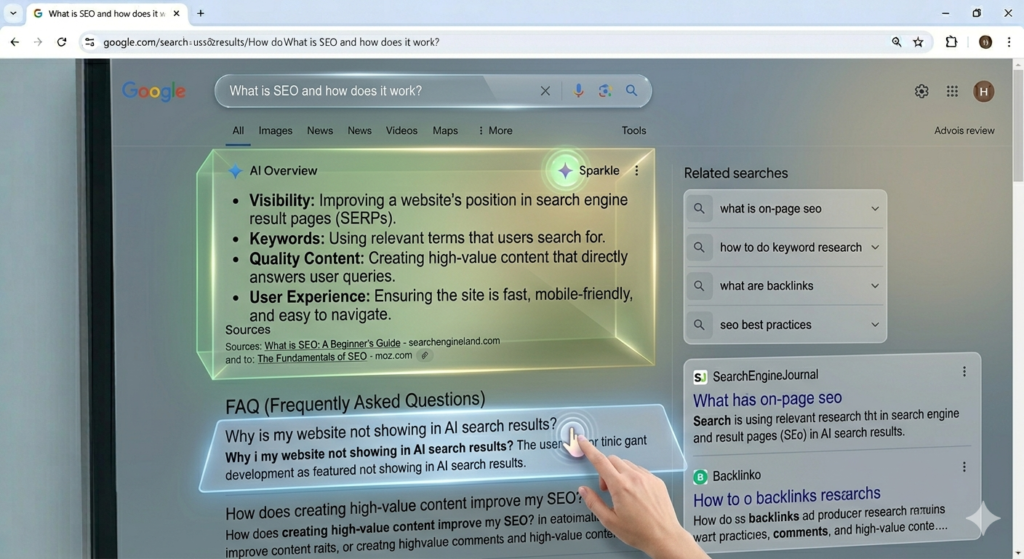
FAQ sections are goldmines for AI Overviews. Google loves content that directly mirrors how people ask questions in real life. Use a question-and-answer format at the end of your articles using natural phrasing.
Think about what users actually type into Google. “Why is my website not showing in AI search results?” is more natural than “reasons for low AI visibility.” Write your FAQs the way a real person speaks.
Step 4: Implement Schema Markup
Add structured data to your website. The most useful types are FAQ schema, HowTo schema, Article schema, and Organization schema. You can use free tools like Google’s Rich Results Test to check if your schema is working properly.
If you are using WordPress, plugins like Rank Math or Yoast SEO make this much easier without needing to write code manually.
Step 5: Improve Your E-E-A-T Signals
Add a clear author bio to every article. Mention the author’s credentials and experience. Link to your social profiles. Get backlinks from reputable websites in your industry. Add references to real data, research, or case studies in your content.
If you are writing about digital marketing for UAE businesses, for example, mention specific local data or real client results when possible. This kind of first-hand experience builds trust with both users and Google.
Step 6: Fix Technical SEO Issues
Run a full technical audit of your website. Use free tools like Google Search Console to check for crawl errors. Use PageSpeed Insights to test your loading speed. Make sure your site is mobile-friendly since most searches in the UAE happen on mobile devices.
Compress your images, fix broken links, and ensure your site loads in under three seconds. These basic fixes can have a significant positive impact on how Google treats your content.
Step 7: Use NLP-Friendly, Semantically Rich Language
Stop writing just for keywords and start writing for meaning. Use natural language that covers a topic from multiple angles. Include synonyms, related terms, and co-occurring phrases that Google would expect to see in a high-quality article on the subject.
For example, if you are writing about AI search engine optimization, naturally include terms like generative AI search, large language model content, search intent, SERP visibility, entity-based SEO, conversational queries, and semantic search relevance. You do not need to force them in; just write thoroughly, and they will appear naturally.
A Real Example of What Works
In early 2024, a digital marketing blog rewrote 30 of its articles using the answer-first format and added FAQ schema to each one. Within 90 days, their content started appearing in Google AI Overviews for competitive keywords, and their organic traffic increased by 43 percent without any paid ads.
The lesson here is simple. You do not need to start from scratch. You can update your existing content with better structure, clearer answers, and proper schema, and the results can come faster than you expect.
When Should You Bring in a Professional?
If you have tried these fixes and still are not seeing results after 60 to 90 days, it may be time to work with an SEO professional or a digital marketing agency.
You should especially consider expert help if your website has deep technical issues, if you are in a highly competitive industry, or if your entire content strategy needs to be rebuilt around topical authority and NLP optimization.
Agencies that specialize in AI-era SEO understand how to align your content with the way Google’s language models process information. This is a newer skill set, and not every SEO agency has caught up with it yet. Choose someone who understands generative search optimization, not just traditional keyword ranking.
Frequently Asked Questions
Q: How long does it take to appear in AI Overviews?
A: There is no fixed timeline. Some websites see results in 30 days after making changes. Others take 90 days or more. Consistency and content quality are the biggest factors.
Q: Do I need to be on page one of Google to appear in AI Overviews?
A: Not necessarily. Google can pull content from pages ranked outside the top 10 if the content is highly relevant and well-structured. However, being in the top 10 does increase your chances significantly.
Q: Is keyword density still important for AI Overviews?
A: Keyword density matters less today than it did five years ago. What matters more is semantic relevance, content depth, and how naturally you cover a topic. Stuffing keywords will actually hurt you now.
Q: Can small websites get featured in AI Overviews?
A: Yes. Niche authority matters more than website size. If you cover a specific topic deeply and your content is well-structured, you can appear in AI Overviews even with a smaller website.
Q: What type of content is most likely to appear in AI Overviews?
A: Informational content that answers specific questions, how-to guides, comparison articles, and definition-based content tend to perform best in AI Overviews.
Final Thoughts
Getting your content into Google AI Overviews is not about gaming the system. It is about truly understanding what your audience is searching for and then delivering the clearest, most helpful, and most trustworthy answer possible.
The shift from traditional SEO to AI-driven search visibility requires a new mindset. You need to think about topical depth, conversational search intent, structured content, and semantic richness all at once. It sounds like a lot, but once you build this habit into your content creation process, it becomes natural.
If you are a business in Dubai, Abu Dhabi, Sharjah, or anywhere else across the UAE, and you want expert help in making your content AI-ready, Qudrat Digital can help you build a content strategy that is designed for where search is heading, not where it has been.
Start with your existing content, apply the fixes in this guide, and give it time. The websites that adapt to AI search today will be the ones dominating tomorrow’s results.
Ready to Improve Your AI Search Visibility?
Get actionable insights to optimize your content, strengthen authority, and increase your chances of appearing in Google AI Overviews.