
You have a great app idea. You have sketched it on a napkin, pitched it to a friend, maybe even named it.
Then someone asks: How long will this take to build?
That one question stops more entrepreneurs in their tracks than any technical challenge. And the honest answer is: it depends. But “it depends” is not useful when you are talking to investors, planning a launch, or budgeting for development. According to a 2024 Clutch survey, more than 60% of first-time app founders underestimate their development timeline by at least 40%. This is not because they are bad at planning. It is because app development strategies involve a web of decisions, people, technologies, and unpredictable events that compound over time.
This guide gives you a clear, realistic picture of app development timelines. Whether you are building a minimum viable product, a consumer-facing platform, or a complex enterprise system, this breakdown will help you plan with confidence.
App Development Timelines & Reality Check
- 3–6 months for a typical MVP app
- 9–18 months for a full-scale app
- 60% Founders underestimate timelines
- 2–3x longer when requirements change mid-build
What Actually Affects the App Development Timeline
Before you can estimate how long your app will take to build, you need to understand the variables at play. These factors shape every hour of work your development team puts in.
Complexity and Feature Scope
A basic to-do list app with local storage can be built in a day. An app with real-time messaging, AI recommendations, payment gateways, third-party API integrations, and multi-language support is a fundamentally different project. Every feature adds time, not just for coding but for design, testing, edge case handling, and documentation.
Real example: Instagram launched in October 2010, just eight weeks after its founding. But it launched with exactly one feature: photo filters and sharing. The full product we know today took years of iteration.
Platform Choice: iOS, Android, or Cross-Platform
Building a native iOS app is one project. Building a native Android app is another. Building both simultaneously doubles your resources. Cross-platform frameworks like React Native or Flutter let one team build for both platforms at once, but they come with their own learning curves and performance trade-offs. Platform decisions are among the most time-sensitive choices you will make early on.
Team Structure and Size
A solo freelancer, a small agency, and a full in-house team all deliver on very different schedules. The right team is not always the biggest. Clear communication, aligned goals, and experienced coordination matter far more than headcount.
- In-house team: Slowest to set up, fastest once aligned. Best for long-term products.
- Outsourced agency: Faster ramp-up, higher initial output. Watch for misaligned incentives.
- Freelancers: Flexible and cost-effective for early stages. Requires strong project management.
- Hybrid model: Core team in-house, specialists outsourced. Often, the most efficient approach for scaling startups.
Design Complexity
UX research, wireframing, prototyping, visual design, and design system creation are not optional extras. They are the foundation. Skipping or rushing design is the single most common cause of expensive rework later in development. Apps with custom animations, unique interaction patterns, or brand-heavy visual identities take significantly longer to design than apps using standard component libraries.
Backend Architecture and Infrastructure
The frontend of your app, what users see and tap, is only half the story. The backend, including databases, authentication systems, server infrastructure, APIs, and admin panels, can take just as long to build. Apps that require scalable cloud infrastructure, microservices architecture, or real-time data synchronization need extra engineering time that first-timers almost always underestimate.
Regulatory and Compliance Requirements
If you are building a health app, a fintech product, or anything handling sensitive personal data in the UAE, you may need to meet regulatory standards such as ADHIC for healthcare or UAE Central Bank guidelines for financial services. Compliance engineering is time-consuming and non-negotiable.
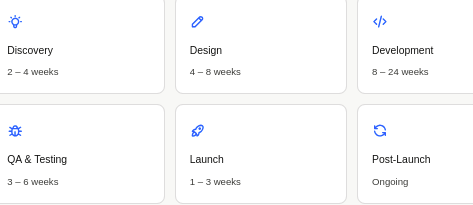
The 6 Core Phases of App Development
Every professional app development process moves through recognizable stages. Understanding each phase helps you plan, budget, and communicate realistically with your team.
Phase 1
Discovery and Strategy (2–4 Weeks)
This is where you define the problem your app solves, who it serves, what features are essential versus nice-to-have, and how success will be measured. Product discovery includes competitor analysis, user persona development, technical feasibility assessment, and the creation of a product requirements document (PRD). Skipping this phase is the fastest way to waste the next six months building the wrong thing.
Phase 2
UX and UI Design (4–8 Weeks)
UX design maps the user journey. Better UI design approach brings it to life visually. This phase produces wireframes, clickable prototypes, and a full design system. For apps with unique interaction patterns, this phase can stretch to three months. Good design is not decoration. It is the architecture of a great user experience, and it directly affects your app store ratings, retention, and revenue.
Phase 3
Frontend and Backend Development (8–24 Weeks)
This is the core build phase. Front-end engineers implement the design in code. Backend engineers build the server, database, APIs, and business logic. Both streams run in parallel in agile teams but require continuous coordination. The more integrations, custom features, and real-time functionality your app needs, the longer this phase takes. Most timeline delays happen here.
Phase 4
Quality Assurance and Testing (3–6 Weeks)
Functional testing, performance testing, security testing, device compatibility testing, and user acceptance testing all happen here. Apps with payment systems or sensitive data require deeper security audits. Do not treat QA as an afterthought. A bug found in testing costs 10 times less to fix than one found by users after launch.
Phase 5
App Store Submission and Launch (1–3 Weeks)
Apple’s App Store review process typically takes 1–3 days but can extend to two weeks for new developer accounts or apps in sensitive categories. Google Play’s review is usually faster. Build submission timelines into your launch plan and always submit well before your public announcement date.
Phase 6
Post-Launch Maintenance and Iteration (Ongoing)
Launch is not the finish line. It is the starting gun. User feedback drives new features. OS updates require compatibility patches. Performance monitoring, crash analytics, and A/B testing inform the product roadmap. Budget at least 20% of your original development cost per year for ongoing maintenance.
Realistic App Development Timelines by Project Type
Here is how timelines break down across common app types. These estimates assume a professional team working full-time with clear requirements from the start.
| App Type | Timeline | What This Includes |
| Simple MVP Entry level | 2 – 4 months | Basic UI, 3–5 core features, one platform, minimal backend, no payment systems |
| Mid-Complexity App Standard | 4 – 8 months | Custom design, user authentication, push notifications, basic API integration, both platforms |
| E-commerce App Standard | 5 – 9 months | Product catalog, cart, payment gateway, order management, inventory sync |
| On-Demand App Advanced | 6 – 12 months | Real-time matching, maps, dual dashboards (user and provider), payments, ratings |
| Social / Community App Advanced | 8 – 14 months | User profiles, feeds, real-time messaging, media upload, notifications, moderation |
| Enterprise App Complex | 12 – 24 months | Custom workflows, role-based access, third-party system integration, compliance, admin portals |
| AI-Powered App Complex | 9 – 18 months | ML model training or integration, data pipeline, recommendation engine, model monitoring |
“Real-world context: Uber’s original app, connecting riders with drivers in San Francisco, took about six months to build the first working version. WhatsApp’s MVP was a simple status app before pivoting to messaging. Great apps start focused and expand through iteration.”
Common Mistakes That Inflate Development Time
Most timeline overruns are predictable. Here are the patterns that consistently add months to projects.
Scope Creep Without Process
A new feature request in week two feels harmless. Then comes another in week four. By month three, the original plan is unrecognizable. Every addition has a ripple effect across design, development, and testing. Without a formal change management process, scope creep is inevitable and expensive.
Vague Requirements at the Start
Phrases like “similar to Airbnb” or “just a simple booking system” are not requirements. They are aspirations. The difference between a vague brief and a detailed product specification document is often three to six months of rework. Invest time upfront in documenting user stories, acceptance criteria, and technical specifications.
Skipping User Research
Building based on assumptions is the most expensive research method there is. Talking to ten potential users before you build can save hundreds of engineering hours. Many apps in the UAE market fail not because of poor execution but because they solve a problem users do not actually have, or solve it in a way users do not actually want.
Underestimating Third-Party Integrations
Payment gateways, mapping services, identity verification, SMS providers, analytics platforms. Each integration carries its own documentation, rate limits, error handling requirements, and sandboxing phase. Teams routinely allocate one week per integration and end up needing three.
Poor Communication Between Design and Development
When developers receive static mockups without interaction specs, they fill in the gaps themselves. Those interpretations rarely match what designers intended. Design handoff tools like Figma with developer annotations, regular design reviews, and shared component libraries prevent this. The cost of misalignment shows up in rework sprints.
How to Build Your App Faster Without Sacrificing Quality
Faster does not always mean cheaper or lower quality. With the right approach, you can accelerate your development timeline while still delivering a product users love.
Start With an MVP Mindset
A minimum viable product is not a low-quality product. It is a focused product. Define your one core value proposition, build only what is needed to deliver that value, launch, and learn. Every feature beyond the core should be validated with real users before being built. This approach cuts initial timelines by 40–60% and dramatically reduces wasted investment.
Use Proven Technology Stacks
Choosing exotic or bleeding-edge technologies for the sake of novelty adds risk and slows hiring. AI Models Are Shaping Mobile App Innovation alongside practical tools like React Native, Flutter, Node.js, Firebase, and AWS are widely adopted because they work, have large communities, and offer extensive documentation. Stability in your technology stack translates directly into development speed.
Adopt Agile Development with Short Sprints
Agile software development breaks the build into two-week cycles called sprints. Each sprint delivers working, testable software. This keeps the team focused, surfaces problems early, and gives stakeholders regular visibility into progress. Teams that use agile methodologies consistently deliver faster than those using waterfall approaches.
Invest in Design Systems Early
A design system is a library of reusable UI components, colors, typography, and interaction patterns. When developers have a well-documented design system to work from, they spend less time making styling decisions and more time implementing features. This investment pays back with speed every single sprint.
Pro insight
Apps built with a design system ship 30–50% faster in later development phases because design-to-code translation becomes standardized. Teams spend less time in review cycles and more time building.
Use No-Code and Low-Code Tools for Non-Core Features
Admin dashboards, email notification systems, CMS integrations, and analytics setups do not always need custom code. Tools like Retool, Firebase, and Webflow can handle these functions at a fraction of the time and cost of custom development, freeing your engineering team for the parts of your app that truly require it.
Plan for App Store Review Time
Build a one to two week buffer before any public launch date for App Store and Google Play reviews. Apple in particular can reject apps for policy reasons that require re-submission. Planning for this avoids the painful experience of announcing a launch date you cannot hit.
Choosing the Right Development Partner in the UAE
For businesses in Dubai, Abu Dhabi, Sharjah, and across the UAE, choosing the right development partner is as important as the idea itself. The UAE market has unique considerations: Arabic language support, right-to-left UI design, local payment gateway integration (like Telr, PayTabs, or Network International), and compliance with TDRA and other regulatory bodies.
When evaluating a development agency or team, look for a portfolio with apps similar to yours, clear communication processes, defined project management methodology, and post-launch support commitments. Ask specifically about their experience with App Store submission in the MENA region, as requirements can differ from Western markets.
Working with a team that understands the regional landscape reduces miscommunication, avoids rework from market misalignment, and can meaningfully shorten your overall development timeline.
Frequently Asked Questions
Q1. How long does it take to build a simple app?
A: It usually takes around 2–4 months to build a simple app with 3–5 basic features. The exact time depends on design quality, backend setup, and how clear the requirements are before starting development.
Q2. What is the fastest way to build an app?
A: The fastest way is to build an MVP (Minimum Viable Product) with only one main feature. Using tools like Flutter or React Native and backend services like Firebase can speed up the process significantly.
Q3. How long does it take to build an app like Uber or Instagram?
A: Fully developed apps like Uber or Instagram take years to build. However, their initial MVP versions can be created in about 3–6 months by a skilled development team with limited features.
Q4. Does iOS or Android take longer to develop?
A: Both iOS and Android development take a similar amount of time when done natively. Using cross-platform frameworks like Flutter or React Native can reduce time by allowing a single codebase for both platforms.
Q5. How long does app testing take?
A: App testing usually takes 3–6 weeks, depending on complexity. This includes functional testing, performance checks, device compatibility testing, and user acceptance testing before launch.
Final Words
Building an app is one of the most rewarding investments a business can make, but only when done with realistic expectations and a solid plan. The difference between a successful launch and a failed one often comes down to clarity of vision, quality of execution, and the experience of the team you work with.
If you are based in Dubai, Abu Dhabi, Sharjah, or anywhere across the UAE and are ready to turn your idea into a product, Qudrat Digital offers end-to-end app development services tailored to the regional market, from discovery and design through to launch and beyond.
Ready to Start Building?
Get a realistic timeline and cost estimate for your app idea, built for the UAE market Get My Timeline Estimate ↗