Let me be straight with you. Most businesses in the UAE are sitting on a goldmine of data and doing absolutely nothing useful with it. They collect numbers, generate reports, and then make decisions based on gut feeling anyway. Sound familiar?
Here is the thing. In 2026, the businesses that are growing fast are not the ones with the biggest budgets. They are the ones who actually understand their data. Whether you are running a Shopify store in Dubai, managing SEO campaigns in Abu Dhabi, or building digital products for clients across the Emirates, smarter data analysis is the one skill that will separate you from your competition.
This guide is for you if you have ever felt overwhelmed by Google Analytics, confused by SEO metrics, or unsure whether your Shopify plugins are actually doing anything useful. We are going to break it all down in a simple, practical way that you can actually apply starting today.
What Is Smarter Data Analysis and Why Does It Matter in 2026
Data analysis is not just about numbers on a screen. It is the process of collecting, cleaning, interpreting, and acting on information to make better decisions. When done smartly, it tells you what your customers want, where they are dropping off, what content is ranking, and which products are selling.
In 2026, Google’s algorithm will become more intelligent than ever. It now uses natural language processing, semantic search, and AI-powered indexing to understand not just what you write, but the intent behind it. This means your data strategy must go beyond basic keyword tracking. You need to understand user behaviour, content relevance, page experience, and conversion patterns all at once.
For businesses in the UAE, where competition is growing quickly across sectors like e-commerce, SaaS, real estate, and professional services, getting your data strategy right is no longer optional. It is the foundation of everything.
Understanding the Data You Already Have
Starting With the Basics of Data Collection
Before you can analyze anything, you need clean and organized data. This is where most businesses struggle. They have Google Analytics set up, but have never configured goals. They have Shopify installed, but have never looked at customer lifetime value. They run SEO campaigns but do not track keyword rankings by intent.
Here are the core data sources you should be pulling from right now:
Google Search Console gives you real search performance data, including impressions, clicks, average position, and the actual queries people use to find you. This is pure gold for SEO.
Google Analytics 4 (GA4) tracks user journeys across your website, including sessions, engagement rate, conversion events, and audience behaviour. If you are still using Universal Analytics, you are already behind.
Shopify Analytics shows you product performance, sales by channel, customer return rates, abandoned cart data, and app performance. Many store owners open this dashboard only to check revenue. That is a huge missed opportunity.
Heatmap tools like Hotjar or Microsoft Clarity show you exactly where users click, scroll, and leave on your pages. This visual data is often more revealing than any number in a spreadsheet.
Third-party SEO tools like Ahrefs, Semrush, or Ubersuggest give you backlink profiles, keyword difficulty scores, competitor gap analysis, and content opportunity reports.
When you bring all of these together, you start seeing patterns that individual tools cannot show you alone.
Using Data to Improve SEO, Design, and Development
How Data Analysis Transforms Your SEO Strategy
Digital Marketing Services in UAE are now more dependent on data intelligence than ever before. SEO in 2026 is deeply connected to how effectively you analyze and act on data. You cannot rank well just by publishing content anymore. Google wants to see topical authority, search intent matching, structured data markup, and a strong user experience signal.
Here is how smarter data analysis improves your SEO performance directly.
Keyword intent mapping is when you group your keywords not just by volume but by the stage of the buyer journey they represent. Informational, navigational, transactional, and commercial investigation keywords all need different content approaches. Data helps you identify which keywords your pages are ranking for versus which ones they should be ranking for.
Content gap analysis is a process where you compare your content with the top-ranking pages for your target queries. Tools like Semrush’s Content Gap feature or Ahrefs’ Keyword Gap will show you topics your competitors cover that you do not. This gives you a clear content roadmap based on real search demand, not guesswork.
Core Web Vitals and page experience data directly impact your rankings. Google measures Largest Contentful Paint (LCP), First Input Delay (FID), and Cumulative Layout Shift (CLS) as part of its ranking criteria. If your development team is not regularly reviewing these scores through Google Search Console or PageSpeed Insights, you are likely leaving rankings on the table.
Internal linking analysis helps search engines understand the structure of your website and distribute page authority effectively. By analyzing your top-performing pages and identifying which pages link to them, you can build stronger topical clusters.
One real pattern that analysts see consistently is this. Pages that receive the most organic traffic are not always the pages that convert best. Data helps you identify this disconnect and fix it, either by improving the content or adjusting the conversion elements on high-traffic pages.
How Data Guides Better Web Design Decisions
The web design process should never be driven by aesthetics alone. Every design decision must be backed by data because it directly affects how users behave on your website and, ultimately, how Google evaluates your site quality.
Bounce rate and engagement rate data tell you whether your landing pages are resonating with visitors. A page with 80 percent bounce rate is telling you something is wrong, whether it is the messaging, the design, the load speed, or the targeting.
Session recordings from tools like Clarity or Hotjar show you exactly where users get confused or frustrated. Maybe your call-to-action button is below the fold. Maybe users are trying to click on an image that is not clickable. This behavioural data is invaluable for UX improvement.
A/B testing data from tools like Google Optimize or VWO gives you statistically significant results on which design variations drive better engagement and conversions. You are not guessing. You are making decisions backed by real user responses.
Mobile versus desktop behaviour data often reveals completely different usage patterns. In the UAE, where mobile internet usage is among the highest in the world, your design must be optimized for small screens first. Analyzing how users on different devices behave gives your development team clear priorities.
Development Decisions Backed by Real Data
Smart developers in 2026 do not just build what clients ask for. They build what the data says will perform. This is a mindset shift that separates good development from great development.
Performance profiling data tells developers which scripts are slowing down the page load. Removing or deferring non-essential JavaScript based on real performance data can reduce load time dramatically and improve both rankings and conversions.
Error tracking through tools like Sentry or Datadog shows developers which parts of a website are breaking in production. Fixing these issues before users complain reduces churn and improves the overall experience signal that search engines measure.
API usage analytics help developers understand which integrations are being used, which are slowing the system down, and which can be optimized or removed entirely.
Shopify and Data Analysis: Unlocking E-Commerce Growth
Why Shopify Store Owners Must Think Differently About Data
Running a Shopify store in the UAE market comes with unique challenges. High competition, seasonal buying patterns, a multilingual customer base, and a rapidly evolving digital landscape all require you to be sharper with your data than ever before. This is where Shopify Store Development Services play a crucial role, helping businesses build data-driven, high-performing eCommerce experiences from the ground up.
Many Shopify store owners install plugins and forget about them. This is a costly mistake. Every plugin you add to your store affects load speed, which affects SEO and conversion rate. Data analysis helps you evaluate whether a plugin is earning its place.
Here are the most critical data points Shopify merchants should be tracking actively.
Customer acquisition cost by channel tells you whether your paid ads, organic traffic, email marketing, or influencer partnerships are actually profitable when factored against the revenue they generate.
Average order value trends show whether your upsell and cross-sell strategies are working. If your AOV is not growing over time, your product bundling and recommendation engine needs rethinking.
Cart abandonment rate by device and traffic source reveals exactly where in the checkout journey customers are dropping off. This is actionable, high-value data that directly impacts revenue.
Product performance data broken down by variant, collection, and time period helps you make smarter inventory decisions and marketing allocation choices.
Shopify plugin performance data, available through your theme’s speed reports and Google PageSpeed, shows which third-party apps are consuming the most render-blocking resources. Removing slow plugins can improve your SEO score overnight.
Real example. A Shopify store selling fashion accessories in Dubai identified through GA4 that over 60 percent of their traffic came from mobile, but their mobile conversion rate was less than half their desktop rate. By analyzing heatmap data, they found users were struggling with the mobile checkout flow. One development fix later, their mobile conversions increased by 34 percent in 30 days. This was not a marketing win. It was a data win.
Turning Data Insights Into Measurable Business Growth
Building a Data-Driven Growth System
Growth without a system is just luck. Smarter data analysis gives you a repeatable system for growth that compounds over time.
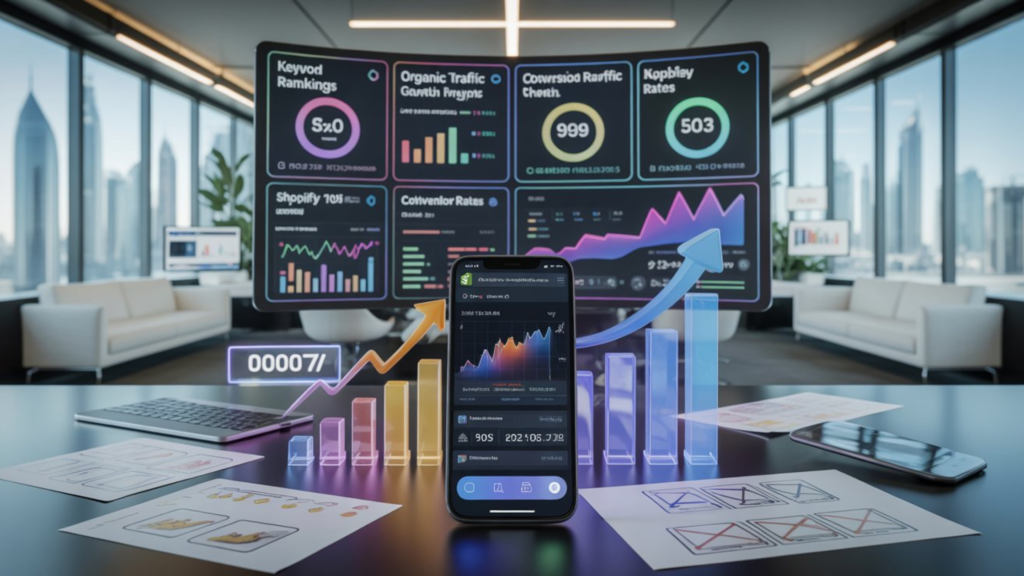
Start by setting up a centralized dashboard using tools like Google Looker Studio (formerly Data Studio) that pulls data from Search Console, GA4, Shopify, and your SEO tools into one place. This gives you a single source of truth for your business performance.
Define clear KPIs tied to business goals, not vanity metrics. Rankings are a vanity metric. Revenue from organic traffic is a business metric. Traffic volume is a vanity metric. Conversion rate from specific landing pages is a business metric.
Review your data on a consistent cadence. Weekly reviews for tactical decisions. Monthly reviews for strategic shifts. Quarterly reviews for channel and investment decisions.
Share data with your entire team, not just the marketing department. Developers need to see page speed trends. Designers need to see user behaviour data. Customer service teams need to see product return data. When everyone works from the same data, decisions align, and growth accelerates.
FAQ: Quick Answers for Smarter Data Analysis
Q1: What is the best free tool for SEO data analysis in 2026?
A: Google Search Console remains the most powerful free tool for SEO data. Pair it with GA4 for a complete picture of your organic performance.
Q2: How often should I review my Shopify analytics?
A: Weekly reviews of sales, traffic sources, and cart abandonment are recommended for active stores.
Q3: Can data analysis help a small business in the UAE compete with larger brands?
A: Absolutely. Data gives small businesses the ability to find niche opportunities, avoid wasteful spending, and move faster than larger competitors who are slower to act on insights.
Q4: What is the connection between Core Web Vitals and rankings?
A: Google uses Core Web Vitals as a ranking factor. Pages that load quickly, respond to user input fast, and maintain visual stability rank better than those that do not, all else being equal.
Q5: How do I know if my Shopify plugins are hurting my SEO?
A: Run your store URL through Google PageSpeed Insights and check the opportunities and diagnostics sections.
Final Thoughts
Data is not complicated. It is just information waiting to be understood. The businesses growing fastest in the UAE right now are not the ones spending the most. They are the ones listening most carefully to what their data is telling them.
Whether you need help building a smarter SEO strategy, improving your Shopify store performance, or making sense of your web analytics, our team at Qudrat Digital works with businesses across the UAE to turn raw data into real growth.
If you are based in Dubai, Abu Dhabi, Sharjah, Ajman, or anywhere across the Emirates and want to start making smarter decisions from your data, now is a good time to explore what a structured data analysis strategy could do for your business.