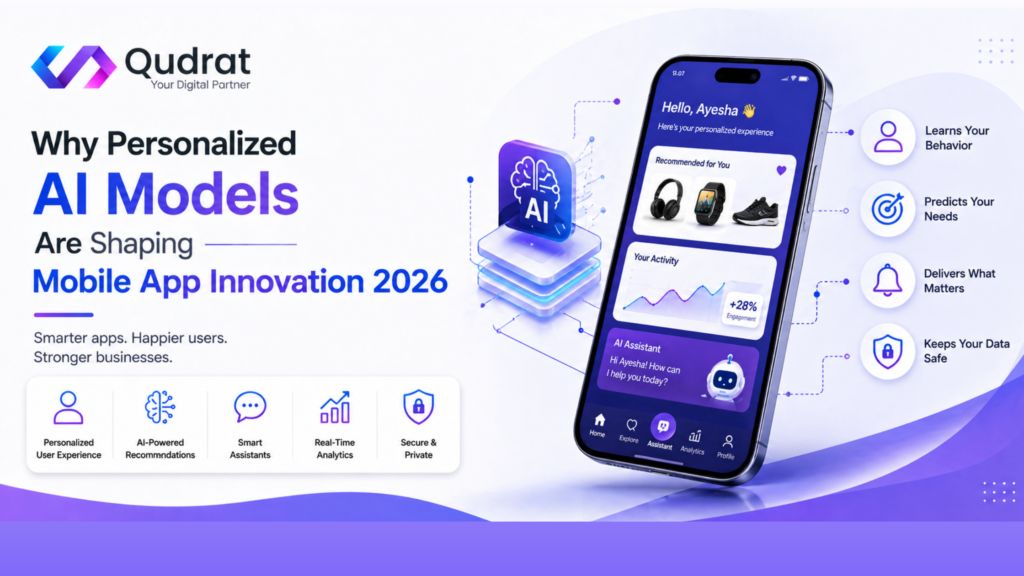
Have you ever opened an app and felt like it just gets you? It suggests exactly what you need before you even search for it. It remembers your habits. It feels less like software and more like a personal assistant. That is not a coincidence. That is personalized artificial intelligence at work, and in 2026, it is completely changing how mobile apps are built, used, and experienced.
Whether you are a business owner in Dubai trying to improve your customer app through smarter mobile app development, or a regular user in Abu Dhabi who just wants a smoother digital experience, the rise of personalized AI models is something that directly affects you. This article breaks it all down in simple terms.
What Is a Personalized AI Model?
A personalized AI model is an artificial intelligence system that learns from individual user behaviour, preferences, and data to deliver a tailored digital experience. Unlike general AI, which gives the same result to everyone, a personalized model adapts over time.
Think of it this way. When you open a music streaming app, and it plays songs you love without you searching, that is a recommendation engine powered by machine learning. When your food delivery app already knows your usual order at lunchtime, that is predictive personalization. When your fitness app adjusts your workout plan based on your recovery sleep, that is adaptive AI working in real time.
In 2026, these are no longer premium features. They are becoming the standard expectation for any mobile app that wants to stay relevant.
Why This Matters Right Now
Mobile app usage globally has surpassed 4.8 billion users, and user attention spans are getting shorter. People delete apps within the first 72 hours if the experience does not feel relevant to them. That is a fact backed by multiple mobile UX studies.
According to Statista, average app retention rates drop to below 25% after just 30 days. The apps that beat this number are almost always those using some form of intelligent personalization.
In the UAE, mobile internet penetration is above 99%, and smartphone usage is among the highest in the world. Consumers here are digitally sophisticated. They expect speed, accuracy, and relevance. A generic one-size-fits-all app simply does not cut it anymore.
This is exactly where personalized AI models are stepping in to close the gap between what users expect and what apps actually deliver.
How Personalized AI Is Driving Mobile App Innovation
Hyper-Personalized User Interfaces
One of the most exciting developments in mobile app innovation is the ability for interfaces to reshape themselves based on who is using them. An AI model can track which features a user accesses most, and then bring those to the front automatically. It can adjust font sizes, colour themes, and navigation layouts based on user interaction patterns.
This is called adaptive UI, and it is powered by on-device machine learning models that analyze behaviour without always needing to send data to a cloud server. This makes it faster and more private.
Apps built with adaptive UI have reported up to 40% higher user engagement because people spend less time searching for what they need.
Predictive Content Delivery
Personalized AI models use natural language processing, collaborative filtering, and contextual signals (like time of day, location, and past sessions) to predict what content a user wants to see next.
News apps, e-commerce platforms, and educational tools are all using this technology in 2026 to serve the right content at the right moment. The result is longer session times, lower bounce rates, and higher conversion rates all signals that Google’s algorithm rewards when crawling and evaluating web and app content.
Conversational AI and In-App Assistants
The integration of large language models directly into mobile apps has made conversational AI a mainstream feature. In-app chatbots and voice assistants are no longer clunky or robotic. They understand context, remember previous interactions, and respond in natural human language.

For businesses in Sharjah, Ajman, or Ras Al Khaimah, this means a customer can open your app at midnight, ask a question in Arabic or English, and get an accurate, helpful response without any human support staff needed. That is a real business advantage, not just a tech trend.
Real-Time Behaviour Analysis
Modern personalised AI models do not just learn from past data. They analyze user behaviour in real time and adjust the app experience instantly. If a user seems frustrated (lots of back-tapping, slow scrolling, exits without completing an action), the app can automatically simplify the interface, offer help, or redirect the user to what they were looking for.
This kind of sentiment-aware design is now being built into e-commerce, banking, and health apps across the UAE.
Privacy-First Personalization
One concern many users have is: what happens to my data? This is a valid and important question. In 2026, federated learning has become a key solution. This is a type of AI training where the model learns from your behaviour on your device without ever sending your personal data to a central server.
Apple and Google have both pushed for this approach through their respective AI frameworks, and app developers are now building privacy-preserving personalization as a core feature, not an afterthought. This is especially important for compliance with UAE data protection regulations.
Common Challenges Businesses Face Without Personalized AI
Many businesses still struggle with high app uninstall rates, low user retention, and poor conversion performance. Some of the most common pain points include:
Users are seeing irrelevant product recommendations and losing trust in the platform. Support teams are getting overwhelmed with repetitive queries that a smart in-app assistant could handle. Apps are feeling outdated compared to competitors who have adopted AI-driven features. Inability to compete with global platforms that already use sophisticated machine learning pipelines.
These are not just technical problems. They are business problems. And they are solvable.
What to Look For When Choosing an AI-Powered App Development Partner
If you are a business in the UAE looking to build or upgrade your mobile app with personalized AI capabilities, here are the key things to look for in a development partner.
First, check if they have experience with machine learning integration, not just basic app development. Building personalized AI features requires a different skill set from standard coding.
Second, ask about their approach to data privacy and compliance. Any reputable partner should be familiar with UAE data laws and global standards like GDPR.
Third, look for proven results. Ask for case studies or examples where their AI-driven apps improved retention, engagement, or revenue for past clients.
Fourth, ensure they offer post-launch support. AI models need monitoring, retraining, and updating as user behaviour evolves. A one-and-done approach does not work for AI-powered apps.
The Future of Mobile Apps Is Intelligent and Personal
We are moving fast towards a world where every app experience is unique to the individual using it. The gap between “smart apps” and “standard apps” is widening every quarter. Businesses that invest in personalized AI now will have a significant competitive advantage in 2027 and beyond.
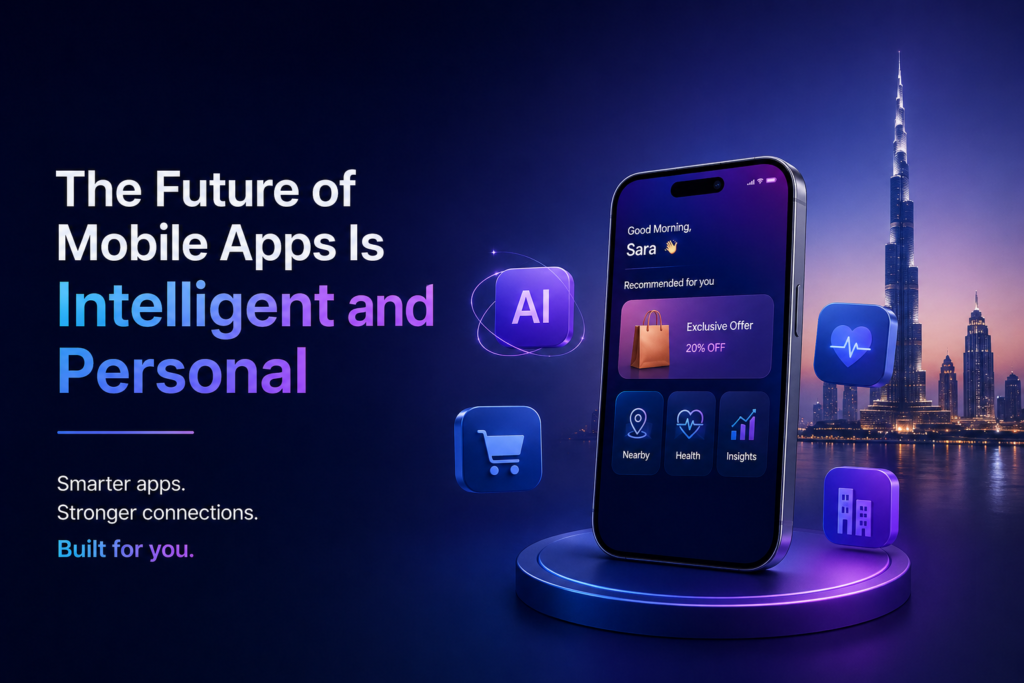
In the UAE, where digital transformation is a national priority under Vision 2031, the demand for intelligent mobile solutions is only going to grow. Whether you are in retail, healthcare, real estate, or hospitality, your mobile app is increasingly the primary touchpoint between your brand and your customer. Making that experience feel personal, relevant, and intelligent is no longer optional.
Frequently Asked Questions
Q: What is a personalized AI model in a mobile app?
A: A personalized AI model is a type of artificial intelligence that learns from individual user behaviour to deliver a tailored app experience.
Q: How does AI personalization improve app retention?
A: By showing users content, features, and recommendations that match their specific interests and habits, personalized AI reduces friction and increases the likelihood that users will return to the app regularly.
Q: Is personalized AI safe for user data?
A: Yes, when built correctly. Technologies like federated learning allow AI models to learn from user behaviour on-device without transmitting personal data to external servers.
Q: Which types of apps benefit most from AI personalization?
A: E-commerce, health and fitness, education, entertainment, banking, and customer service apps.
Q: How much does it cost to build an AI-personalized mobile app in the UAE?
A: Costs vary depending on the complexity of the AI features, the platform (iOS, Android, or both), and the development team.
Q: Can small businesses in the UAE afford AI-powered apps?
A: Yes. With the availability of pre-built AI APIs, machine learning libraries, and cloud-based tools.
A Soft Note for UAE Businesses
If you are based in Dubai, Abu Dhabi, Sharjah, or anywhere across the Emirates, and you are thinking about upgrading your mobile app with smarter, more personalized features, it is worth having a conversation with a team that genuinely understands both technology and the UAE market.
Qudart Digital is a Digital Marketing & Development Agency in the UAE that works with businesses across the UAE to build mobile applications that are intelligent, user-centred, and designed for real-world results. If you are curious about what personalized AI could do for your app, reaching out for a conversation is always a good first step.
The future of mobile apps is personal. The best time to start building yours is now.